


Fundamentals to Deployment: Bridging AI in Medicine


Organised under Universiti Malaya (UM)’s AI in Medicine Initiative, and led by the Department of Mechanical Engineering and Department of Electrical Engineering, Faculty of Engineering, with support from the Centre for Research in Industry 4.0 (CRI 4.0) and the Department of Media and Communication Studies, Faculty of Creative Arts, the 2nd AI in Medicine Summer School and Bootcamp was held from 27 July to 2 August 2026.
Summer School
The first three (3) days were the Summer School where 2 different classes were held: Clinical Foundations & AI Introduction, and Core AI Skills & Hands-on Learning. Here, researchers learnt to understand the clinical perspective and how AI would be incorporated in the medical workflow, as well as machine learning, deep learning and medical imaging. The highlight of the summer school was a hands-on team challenge where researchers used machine learning for wrangling medical data. The winning team was Group 2, and they received a prize of RM1,500 model that they developed.

Expert Panel Forums
The Summer School and Bootcamp were in full swing by the time Friday (31st July 2026) came, where two (2) expert panel forums were scheduled.
After welcoming and opening speeches by Dr. Muhammad Khairi Faiz bin Ahmad Hairuddin, Head of Mechanical Engineering Department, Faculty of Engineering and Prof. Ir. Dr Nik Nazri Nik Ghazali, Dean of the Faculty of Engineering, respectively, the forum sessions began. With the aim to equip researchers with the fundamentals to bridge AI and medicine, the forums were broken into two (2) aspects: 1. AI in Healthcare Practice and Deployment, and 2. Governance, Validation and Trust in Healthcare AI.

Panel 1: AI in Healthcare Practice and Deployment
Moderator: Ms. Hazween Hassan (News Editor / Chat Show Host)
Panellists:
(i) Dr. Wan Nur’ismah binti Wan Ahmad Kamil (Faculty of Biotechnology & Biomolecular Sciences, Universiti Putra Malaysia)
(ii) Assoc. Prof. Dr Noor Akmal Shareela binti Ismail (Faculty of Medicine, Universiti Kebangsaan Malaysia)
(iii) Prof. Dr Victor Hoe Chee Wai bin Abdullah (Faculty of Medicine, Universiti Malaya)

In the 1st session, queries such as how AI is being used or will be used as well as accountability and ethics of AI in the healthcare sector were posed to the panellists.
Dr. Wan Nur’ismah stressed that AI is merely a tool and that its uses were already being seen in disease prediction based on current data that is fed into AI agents. She did mention that developing and validating the AI tool to be relevant to a Malaysian population was key to ensuring AI’s use in healthcare practice was justified.
AP Dr. Noor Akmal Shareela on the other hand enlightened on the use of AI in UKM’s pharmacy where it categorises prescriptions based on urgency, which ensures those that are in most urgent need of their medication receives it first. She did clarify that patient privacy and consent when integrating into readily available platforms is of paramount importance, as hesitance of AI use can be detrimental to the overall healthcare practice system.
Prof. Dr. Victor Hoe reiterated that while in itself it isn’t a new term, AI’s implementation into healthcare practice was inevitable with long waiting times and confusing appointment scheduling plaguing patients. He said that while medicolegal issues may rise due to use of AI to access patient data and the use of multiple platforms, the Ministry of Health’s Digital Health arm is gearing up to meet the challenge to ensure no hangups occur in the implementation of AI in healthcare practices.
Panel 2: Governance, Validation & Trust in Healthcare AI
Moderator: Ms. Hazween Hassan (News Editor / Chat Show Host)
Panellists:
(i) Prof. Dr. Adina binti Abdullah (Faculty of Medicine, Universiti Malaya)
(ii) Mr. Ridzwan Mahdi (Head of Cybersecurity Governance, Risk and Compliance (GRC) & Data Protection, Maxis)
(iii) Mr. Yong Shang Hua (Centre for Foundation Studies, Universiti Malaya)

Pivoting from the deployment of AI in healthcare practice, the 2nd session focused on how the governance, validation and trust of AI usage in healthcare come into play. Concerns on the system and infrastructure to be used, negligence and the perceiving of AI as a separate entity as well as data privacy and security being a national threat were questions asked to the panellists.
Mr. Shang Hua, highlighting his legal background, clarified that blanket rules on AI regulations help reduce rigidity but cover the bases in a fast-changing field that has only just been introduced. He mentioned that although doctors do not need to disclose the use of AI if it is used to reconfirm diagnoses, AI should always be viewed as a supporting system which should not be held accountable should there be an error in the treatment plan, as the onus is wholly on the healthcare professional.
Mr. Ridzwan, speaking on his corporate background experience, highlighted the need to always read the fine print when agreeing to terms and conditions, especially with the introduction of the Personal Data Protection Act (PDPA). He did raise a valid point that AI is a probabilistic tool, which responds based on the data that it has been fed, which can be benefitted both ways. If patients are willing to allow their anonymised records to be used to train the model, the AI tool can then in turn respond better based on the records it has been given, thus boosting trust in the use of AI in healthcare.
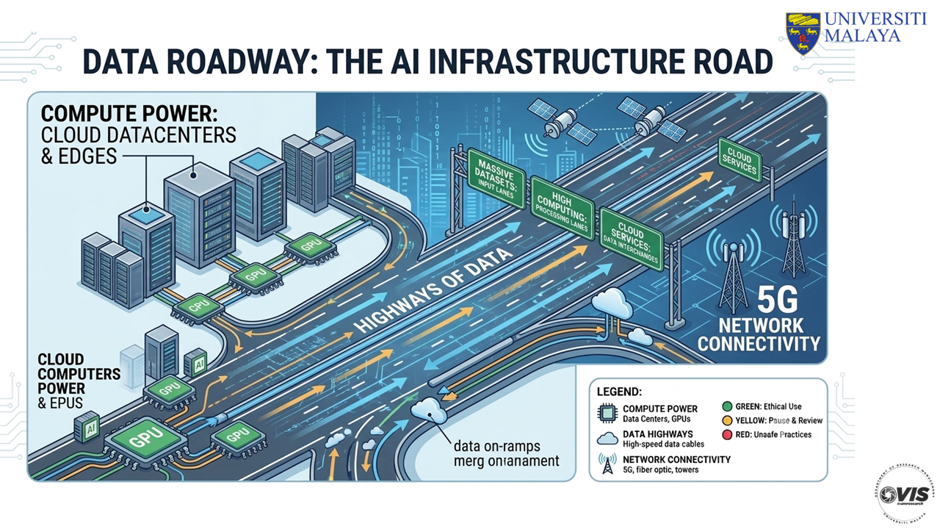
Prof. Dr. Adina began by providing the perfect analogy of AI, its infrastructure and regulation as a car, a road and road safety rules, respectively (refer to the image below). Prof. Dr. Adina also shared her concern that people are not aware of what alternatives are there to current treatment plans that doctors are suggesting and that empowering the Malaysian community is the biggest challenge when it comes to governing and validating AI in the healthcare system. She did raise a plea for the Malaysian Medical Corporation to be further empowered so it can step up to help issues on cybersecurity, especially when AI is to be used on patient records, as any misuse of medical records can have large implications.
Figure 1: How AI, its infrastructure and regulations can be equated to a car, road systems and road safety rules (generated using AI based on description from Prof. Dr. Adina) below.



Bootcamp
The 2nd AI in Medicine Summer School & Bootcamp was wrapped up with a bootcamp on baseline model development incorporating Edge AI fundamentals and deployment followed by a Team Innovation Challenge. The Excellence Challenge for the bootcamp was won by the following group and their invented models, with each team receiving RM900.
Group | Members | Title |
4 | Ahmad Hathim Bin Ahmad Azman | CellSight AI- Schistocytes Counter |
Lai Ngan Shan | ||
Sadia Azmin Anisha | ||
9 | Ashley Cheong | DxCue - Your AI Post-Diagnosis Assistant (CPG-aligned decision support for common diseases) |
Lam Jing Kai | ||
Wong Jia Yu | ||
3 | Dr. Elan Selvi Anandan | CareLink: Your Health, Made Clearer (AI-Powered Support Bridging the Post-Clinic Confusion Gap) |
Khairul Izwan Bin Hashim | ||
Nur Irdina Danisha Binti Zohairen | ||
Dr. Naadira Faa'iza Binti Mazlan | ||
8 | Muhammad Afiq Bin Rohimi | Cun Mask |
Rejuwan Shamim |
Conclusion
To sum it up, the AI in Medicine Summer School and Bootcamp was a huge success based on the novel ideas proposed and fruitful discussions held. It is hoped that more institutions implement similar events to further brainstorm and guide the role of AI in medicine, healthcare practice and ultimately, how it can be utilised to its best to ensure proper care is delivered to everyone.
Sustainable Development Goals (SDGs) Addressed:
 Through the betterment of healthcare with the introduction and complementation of artificial intelligence (AI) |  Through the upskilling of students, clinicians, and researchers in cutting-edge technology |
 Through the improvement and innovation in the field of healthcare services to better serve the community. |  Through bridging healthcare accessibility gaps between urban and rural or underserved communities, democratising diagnostics and specialised care |
 Through bringing together different faculties, external universities, industry partners, and government bodies that inherently foster multi-sectoral collaboration |
Author:
Jaiyogesh Ramesh Patel
Research Outreach & Visibility Centre (OVIS), JPP, UM
Copy-editor:
Siti Farhana Bajunid Shakeeb Arsalaan Bajunid
Research Outreach & Visibility Centre (OVIS), JPP, UM


Comments