


What Consumers Want (and Miss) When Buying Halal and Safe Cosmetics


For millions of Muslim and conscious consumers worldwide, buying cosmetics isn't just about shade matching or skin type, it’s an exercise in alignment with faith, personal ethics, and health. While the market for Halal cosmetics is surging, everyday shoppers face a confusing maze of information. How do consumers determine if a lipstick or moisturizer is genuinely safe, pure, and Halal?
Searching for "Tayyib" in a Bottled World
When a consumer picks up a cream labelled "Halal," they are looking for more than a guarantee that it contains no pork fat or alcohol. In Islamic tradition, Halal goes together with Tayyib—a concept meaning pure, clean, wholesome, and safe. To the shopper, a true Halal cosmetic should be gentle on the skin, ethically sourced, and free from harmful toxins.
However, standing in a brightly lit store aisle or scrolling through an e-commerce app, consumers quickly realize that finding clear, trustworthy information is much harder than it sounds.
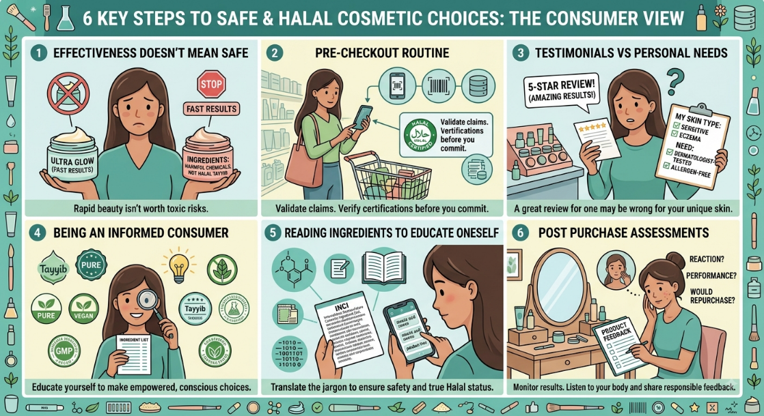
Effectiveness Doesn’t Mean Safe
Rapid results or high performance shouldn't come at the cost of long-term health or ethical compliance. A cream that quickly brightens skin might seem like a miracle worker, but without proper safety screening and Tayyib (purity) standards, it could contain harsh, toxic, or non-halal compounds that compromise both your skin barrier and your values.
S.E.M.A.K. Before Checkout
Before tapping your card or hitting "place order," establish a systematic verification habit. Take a few extra moments to scan QR codes, check for recognized Halal certification bodies, and verify regulatory registration numbers to ensure the brand's claims are legitimate rather than empty marketing. For this, Dr Fatin proposes the acronym S.E.M.A.K.
S – Siasat Produk / Investigate Product
Do not believe every claim, advertisement or viral fad.
E – Evaluasi Label & Bahan / Evaluate Label & Ingredients
Read the ingredient list and label to ensure understanding.
M – Maklumat Rasmi / Official Information
Check status of the cosmetic item through official channels and proper authorities.
A – Aspek Halal & Keselamatan / Safety & Halal Aspects
Make sure to consider the safety and Halal aspect, and not just the effectiveness of the product.
K – Kenal Reaksi Diri / Know Personal Reactions
Use it wisely and take action if side effects present themselves.
Testimonials versus Personal Needs
Glowing five-star reviews and viral influencer endorsements are compelling, but they rarely tell the whole story. What works wonders for a reviewer with resilient skin might trigger an allergic reaction or fall short of the specific safety and Halal criteria required for your unique skin type and personal standards.
Being an Informed Consumer
True empowerment comes from shifting from a passive shopper to an active, conscious consumer. By understanding the core principles of Halal-certified and safe cosmetics, you build the confidence to navigate misleading "halal-washing" or "greenwashing" claims and choose brands that genuinely align with your ethics.
B.A.C.A. to Educate Oneself
Don't let complex INCI (International Nomenclature Cosmetic Ingredient) lists intimidate you. Taking the time to look up unfamiliar terms—like distinguishing between permissible fatty alcohols and non-halal derivatives—allows you to educate yourself before making a purchase, ensuring complete transparency in what you apply to your body. Dr Fatin proposes the acronym B.A.C.A. here to be done when assessing the ingredients.
B – Baca Senarai Penuh Bahan / Read The Full Ingredient List
Don’t just rely on the ingredients on the front of the product, and ensure the ingredient list is complete and not unclear. This can point to dishonest reporting from the side of the producer, potentially meaning a risky product.
A – Awasi Bahan Alahan atau Bermasalah / Beware of Allergens or Problematic Materials
Understand what your allergies and what ingredients previously did not react well with your skin. This can eliminate products that may not be safe for personal use, aside from the Halal aspect.
C – Cari Bahan yang Perlukan Perhatian Khas / Look for Ingredients that Require Special Attention
For the public, a long-winded list of ingredients may be overwhelming, hence, the National Pharmaceutical Regulatory Agency (NPRA) can educate consumers on what red-flag ingredients consumers should be aware of, as well as nonsensical claims such as rapid whitening / scar healing. In addition, consumers can utilise online searches to ensure any unrecognisable ingredient is indeed safe to be used, as well as a regular cosmetic ingredient.
A – Ambil Tindakan Jika Perlu / Take Action If Needed
If at any point, consumers are unsure or confused with the ingredients, they can always cross check with NPRA databases to ensure legitimacy of the ingredient as a compound for cosmetics, or even consult with healthcare professionals to confirm the active ingredients in the cosmetic product to ascertain the purpose of said ingredient in the cosmetic product.
Post Purchase Assessments
The journey doesn't end at the register. Once you start using a product, actively monitor how your skin responds over time, assess whether the product fulfills its safety promises, and use that experience to make better-informed choices, or share constructive feedback with the community in the future.
For the modern consumer, buying Halal cosmetics is a personal decision rooted in trust. When producers fail to bridge the information gap, shoppers are left feeling confused, sceptical, or overwhelmed. By demanding clearer labels, intuitive digital tools, and plain-language ingredient breakdowns, consumers are reshaping the industry – pushing brands to prove that safety and Halal integrity are truly integrated.
SDGs Addressed
 | Through recommendation of producing safe and halal cosmetics |
 | Through educating producers and consumers on how to navigate the production and consumption of safe and halal cosmetics |
 | Through empowering producers to come up with better solutions to address safety and halal in the cosmetics industry |
Researcher Featured:

Dr Fatin Nur Majdina binti Nordin
Department of Fiqh-usul and Applied Sciences,
Academy of Islamic Studies, Universiti Malaya
Area of Expertise:
Health Education and Promotion > Religion and Society > Other Al-Quran and Al-Sunnah N.E.C
Get to know the researcher
Dr Fatin Nur Majdina Nordin is a Senior Lecturer at the Department of Fiqh-Usul and Applied Sciences, Academy of Islamic Studies, Universiti Malaya. Her research centres on the integration of Islamic knowledge and health sciences to promote holistic health, well-being, and informed decision-making through interdisciplinary research. Her current work aims to advance interdisciplinary models that integrate Islamic values, scientific evidence, and community engagement to support holistic well-being, sustainable health practices, and resilient communities.
For further inquiries, please contact:
Email: fatinmajdina@um.edu.my
Tel: +603-7967 6162
ORCID ID: https://orcid.org/0000-0002-6153-4749
Web of Science (WoS): https://www.webofscience.com/wos/author/record/HTM-3703-2023
Google Scholar: https://scholar.google.com/citations?user=5jRfVRYAAAAJ&hl=en
Author:

Jaiyogesh Ramesh Patel
Research Outreach & Visibility Centre (OVIS), JPP, UM
Copy-editor:
Siti Farhana Bajunid Shakeeb Arsalaan Bajunid
Research Outreach & Visibility Centre (OVIS), JPP, UM

Comments