


A Visionary Scholar Reimagining Tasamuh for Malaysia’s Future
- UM Research
- Dec 29, 2025
- 7 min read


Professor Dr. Khadijah Binti Mohd Khambali @ Hambali
Department of Usuluddin and Da’wah, Academy of Islamic Studies
Director, The Universiti Malaya Centre for Civilisational Dialogue, Universiti Malaya.
Area of Expertise:
Comparative Religion, Religious Studies, Interfaith Dialogue, Mualaf Community, and Islamic Thoughts.
A Scholar Serving the Nation
What sets Professor Dr. Khadijah apart is the seamless way she bridges scholarship and real-world impact. She has served the nation through multiple high-level committees, including the National Security Council (2010–2013) and the Research Committee of the Wasatiyyah Institute Malaysia (2017–2018). She is also an active and long-serving member of the Islamic Religious Council of Selangor (MAIS) from 2018 to the present, as well as the Selangor State Fatwa Committee. Her service extends to the Selangor State Religious Control Committee, the Malaysian Qualifications Agency as an Islamic Studies Programme Expert, Jabatan Kemajuan Islam Malaysia (JAKIM) as a committee member on Islamic media since 2020, and JAIS for long-life learning module development. She has provided affidavits for the Attorney General’s Chambers and the National Security Council on sensitive religious legal matters, including issues related to the “Allah” sentencing cases. She also supports NGOs, including ALUMNI Academy of Islamic Studies (ALIM), demonstrating her commitment to community-based engagement.
Her editorial contributions are equally significant. She serves as Chief Editor of Al-Ummah Journal under JAIS and sits on the editorial boards of AFKAR Journal (a SCOPUS-Q2 publication) and the Islamic Journal in Turkey. These positions highlight her role in elevating Islamic scholarship both nationally and internationally.
GPT3M: Building Tasamuh for a Multi-Ethnic Malaysia
At the core of Prof. Dr. Khadijah’s recent work is the groundbreaking national research project, Garis Panduan Tasamuh Masyarakat Multi-Etnik Malaysia (GPT3M). This two-year program, funded at RM150,000 and running from April 2025 to March 2027, sets out to formulate a comprehensive framework for strengthening tasamuh—or tolerance—within Malaysia’s multicultural context. Using a combination of literature review, interviews, surveys, and focus group discussions, the study brings together an extraordinary range of stakeholders, including muftis, legal scholars, educators, media representatives, leaders of various faiths, and policymakers. The goal is to develop a robust blueprint for inter-ethnic and inter-religious harmony that aligns with Malaysia’s Madani framework.
The study revolves around three major objectives. The first seeks to analyse the role of tasamuh in strengthening inter-civilisational relations through dialogue. The second explores the boundaries of inclusivity to ensure that tolerance does not compromise cultural or religious identity. The third examines the integration of tasamuh principles within Malaysia’s Madani educational curriculum, with a particular emphasis on how these values can be embedded meaningfully in secondary education. These objectives are pursued through thematic, comparative, and descriptive analyses, effectively combining academic rigor with societal relevance.


The Four Pillars of GPT3M
GPT3M is structured into four sub-programs, each addressing a key dimension of tasamuh. The first, led by Prof. Dr. Khadijah herself, focuses on conceptualising tasamuh within a Madani society through the lens of inter-civilisational dialogue. This theme is explored with team members from Universiti Malaya and Universiti Kebangsaan Malaysia. The second sub-program examines Malaysia’s legal frameworks, especially constitutional rights related to tolerance, and is led by Associate Professor Dr. Mohd Zaidi Daud. The third sub-program explores the limits of tasamuh in multicultural festivities and traditions under the leadership of Dr. Shahidra Abdul Khalil, while the fourth investigates how tasamuh can be implemented through Madani education to strengthen unity and harmony among the younger generation under Associate Professor Dr. Tengku Sarina Aini Tengku Kasim. Each sub-program draws strength from interdisciplinary collaboration and the expertise of respected scholars nationwide.[1]
Milestones, Impact, and Scholarly Excellence
The project has achieved remarkable milestones within a short time. GPT3M won both Gold and Platinum Awards at the International Poster Competition (IPC) during MiTA25, held from 26 to 29 May 2025 at Universiti Malaya’s Academy of Islamic Studies. Conceptually, the team has developed the Model Tasamuh Masyarakat Multi-Etnik Malaysia (MT3M) along with detailed proposals for guidelines on multi-ethnic festive celebrations. The project has also produced significant academic outputs, including a SCOPUS-indexed article in Afkar: Jurnal Akidah & Pemikiran Islam titled “Guidelines for Muslim Visits to Non-Muslim Places of Worship in Malaysia: A Review from the Perspectives of Aqidah, Comparative Religion, Fiqh and Law”, a Web of Science article under review in the Journal of Sakarya University Faculty of Theology, and two other articles in draft stage for SCOPUS and MyCite journals. Two international book proposals were submitted to Cambridge Press and Routledge respectively under the titles “Harmony in Diversity: Navigating Multiracial Coexistence Through Islamic and Legal Perspectives in Malaysia” and “Fostering Tasamuh: Guidelines and Educational Strategies for a Harmonious Multi-Ethnic Madani Society in Malaysia.” Two active master’s students, Amiratul Najihah and Safiah Najwa, are currently involved in the research, contributing to the project’s academic sustainability.

GPT3M has also organised two major Focus Group Discussions. The first, held on 18–19 August at Geno Hotel Subang Jaya, brought together key experts in Aqidah, Fiqh, Law, and Education, including muftis from Selangor, Sabah, and Sarawak, the Director General of IKIM, legal advisors from MAIS, and officers from Malaysia’s Islamic Education Division. The second FGD, held on 2 September at the Academy of Islamic Studies, gathered representatives from Christianity, Hinduism, Buddhism, Bahá’í communities, and Soka Gakkai Malaysia, facilitating a vibrant exchange of interfaith perspectives. The project’s visibility was further strengthened through its selection under the Research Visibility Enhancement initiative by the Outreach and Research Visibility Division (OVIS), Universiti Malaya.
Transforming Research into Real-World Impact
The relevance of GPT3M extends deeply into the fabric of Malaysian society. Its impact can be seen across three major areas. Firstly, the framework enhances social unity by offering practical guidance on integrating tasamuh into daily life. Through its emphasis on mutual respect and cultural understanding, the study aligns with national aspirations for a just and ethical Madani society and contributes to SDGs 3, 11, and 16. Secondly, the research offers tools to balance social harmony with the preservation of cultural identity, helping communities coexist without compromising their beliefs or traditions. Thirdly, its development of tolerance education for secondary schools helps cultivate a generation equipped to navigate the challenges of globalisation, digitalisation, and growing multicultural complexity, supporting long-term societal resilience in line with SDG4 and SDG11.
Expanding Reach Through Collaborative Projects
Beyond GPT3M, Prof. Dr. Khadijah continues to work on several collaborations, including the Petaling Jaya Sustainable Community Grant for the project “PJ Harmony: Interfaith and Cultural Literacy,” a joint Harmony Charter study with IKIM, and initiatives promoting interfaith dialogue among Malaysia’s multi-ethnic Madani communities in partnership with the UM Centre for Civilisational Dialogue. These projects reflect her enduring commitment to building cohesive communities through engagement, scholarship, and policy work.
Navigating Challenges with Wisdom and Integrity
Researching tasamuh in a sensitive, multi-ethnic and multi-religious landscape poses significant challenges. Prof. Dr. Khadijah and her team often had to navigate differing interpretations of tolerance among scholars, community leaders, and religious authorities. Achieving consensus on the boundaries of inclusivity required delicate negotiation and thoughtful engagement. Yet these challenges revealed powerful insights: tasamuh is not passive acceptance, but an active commitment to justice, empathy, and principled coexistence. The process underlined the centrality of dialogue as both an approach and a goal, reaffirming that genuine tolerance requires moral courage and continuous effort supported by strong institutions.
Inspired by the Vision of a Compassionate Society
Prof. Dr. Khadijah’s motivation is deeply anchored in the belief that tasamuh is a cornerstone of sustainable peace. In Malaysia’s rich landscape of cultural and religious diversity, she sees tasamuh as a vital instrument for strengthening social cohesion. Her work is inspired by the aspiration to build a compassionate, balanced, and inclusive society, and she is continually encouraged by the willingness of diverse communities to participate in meaningful dialogue. Through research, education, and policy reforms, she believes Malaysia can deepen its culture of mutual respect and shared humanity.
A Future Built on Education, Policy, and Global Dialogue
Looking ahead, Prof. Dr. Khadijah is excited about translating the GPT3M framework into nationwide policies, educational modules, and community programs. Integrating tasamuh into Malaysia’s curriculum stands out as a promising direction, one that will shape future generations to be academically competent as well as ethically grounded. She also envisions future research comparing tasamuh practices across other plural societies, enabling Malaysia to contribute to global conversations on coexistence. The development of media and digital platforms dedicated to interfaith understanding is another area she aims to advance, recognising the power of technology in shaping the future of dialogue. “This,” she notes, “is the recipe of unity in diversity.”

A Message to Young Researchers and the Malaysian Public
To young scholars, she offers advice born from years of experience: pursue research on tasamuh and inter-ethnic relations with humility, intellectual openness, and sensitivity to lived realities. She emphasises that research in this field carries a moral responsibility, requiring empathy, justice, and a genuine desire to uplift society. To the public, her message is equally profound—understanding is the beginning of tasamuh. By listening before judging and embracing diversity as a strength rather than a barrier, individuals contribute to building a more compassionate, resilient nation. In a world fractured by misunderstanding, practicing tasamuh is not merely admirable; it is essential.

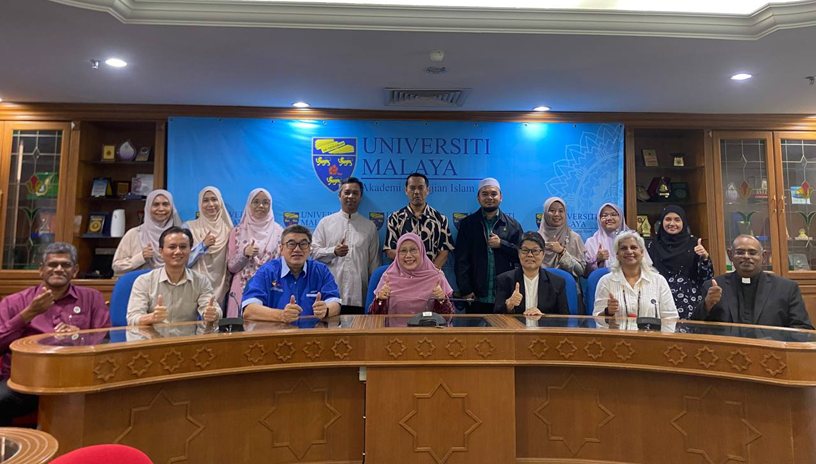
Prof. Dr. Khadijah Mohd Khambali@Hambali’s team including young researchers
In essence, Prof. Dr. Khadijah Mohd Khambali@Hambali’s scholarly journey reflects far more than academic excellence; it embodies a lifelong dedication to cultivating understanding across cultures, strengthening Malaysia’s ethical foundations, and nurturing a society capable of embracing diversity with dignity and compassion. Her work through GPT3M and her broader contributions stand as a testament to the power of knowledge when anchored in service, humility, and a vision for collective harmony. As Malaysia continues navigating the complexities of a multi-ethnic, multi-religious landscape, her research offers not only guidance but hope — a reminder that unity is not achieved by erasing differences, but by honouring them through principled dialogue, mutual respect, and the enduring values of tasamuh that she so passionately advances.
#GPT3M #EthicsofUnity #UnityinDiversity #Tasamuh #SocialHarmony #UnityInDiversity #PeacefulCoexistence #EthicalSociety #IslamicStudies #Usuluddin #Aqidah #Fiqh #Wasatiyyah #ContemporaryIslam #InterfaithDialogue #ReligiousStudies #MadaniSociety #MalaysiaMadani #PublicPolicy #NationalUnity #ReligiousGovernance #SocialCohesion #UniversitiMalaya #AcademyOfIslamicStudies #UMResearchers
Researcher featured:
Professor Dr. Khadijah Binti Mohd Khambali @ Hambali
Department of Usuluddin and Da’wah, Academy of Islamic Studies, Universiti Malaya
Director, The Universiti Malaya Centre for Civilisational Dialogue, Universiti Malaya.
For inquiries, please contact:
T: +603- 7967 6066
Author:
Ms Puungkodi Paramasivam

She is a fast-track PhD candidate at the Faculty of Languages and Linguistics, Universiti Malaya, who finds solace and purpose in writing amidst the challenges of academic research. This is her third contribution to the UM Research Bulletin, a platform she values for showcasing groundbreaking work while allowing her to channel her creativity. Writing, she says, serves as a positive distraction from the demands of her PhD journey, enabling her to engage meaningfully with diverse fields of study. Proud to be an author under the UM Research Bulletin, Puungkodi continues to highlight innovative research and inspire others with her thoughtful narratives.
Copyedit:
Siti Farhana Bajunid Shakeeb Arsalaan Bajunid, Assistant Registrar, UM


Comments