


Exploring the Marvels of Microalgae: The Concrete Healer

Updated: Aug 12

Introduction
The ever-evolving field of engineering has always been one that marvels the mind and challenges the boundaries of achievements. As a nation with growing cities and expansive industrialisation, sustainability never leaves the equation when it comes to preservation and environmental governance. This article features the material that makes up the four walls of our home and infrastructure, the self-healing concrete, using microalgae, pioneered by one of Universiti Malaya’s leading researchers in civil engineering, Prof. Ir. Dr. Ubagaram Johnson Alengaram.

“Currently validated at Technology Readiness Level (TRL) 4 with patent drafting in progress, the innovation demonstrates strong potential for application in self-healing concrete systems, infrastructure rehabilitation, marine structures, and sustainable building materials.”- says Prof. Ir. Dr. Ubagaram Johnson.
This research project addresses the pertinent issue of concrete cracking, which affects the durability and sustainability of modern infrastructure. Conventionally, labour- and material-intensive measures are undertaken for the repair of cracks and crevices. More often than not, continuous monitoring and maintenance are required, which results in growing refurbishment costs.
Self-Healing of Concrete cracks by using Microalgae: The Technicalities and Regenerative Abilities
Prof. Ir. Dr. Johnson’s research team endeavours in an innovation that is bio-based and ecological, using a blue-green microalgae species called Arthrospira platensis to “heal” cracks in cementitious materials through Microbially Induced Calcite Precipitation (MICP). Cement cracks are detrimental as they allow the flow of water and corrosive agents through small gaps over time, significantly reducing structural performance and service life.


The technology employs microalgae grown in modified culture media containing concrete wash wastewater, enabling waste valourisation while producing biologically active biomass. Through photosynthetic activity, the microalgae induces the precipitation of calcium carbonate (CaCO₃), which subsequently fills and seals the cracks in the cement mortar.. Furthermore, laboratory tests demonstrated successful crack healing within 12 days, achieving up to 97.8% recovery of compressive strength. Microstructural characterisation further confirmed that calcite was the predominant mineral responsible for the healing process.
Technical Insights

To illustrate the above cultivation process, the research team developed a sustainable cultivation method by replacing conventional growth media with recycled concrete wash wastewater, thereby transforming an industrial by-product into a valuable resource. This approach not only supports healthy microalgae growth but also promotes waste reuse and more environmentally friendly biomass production.
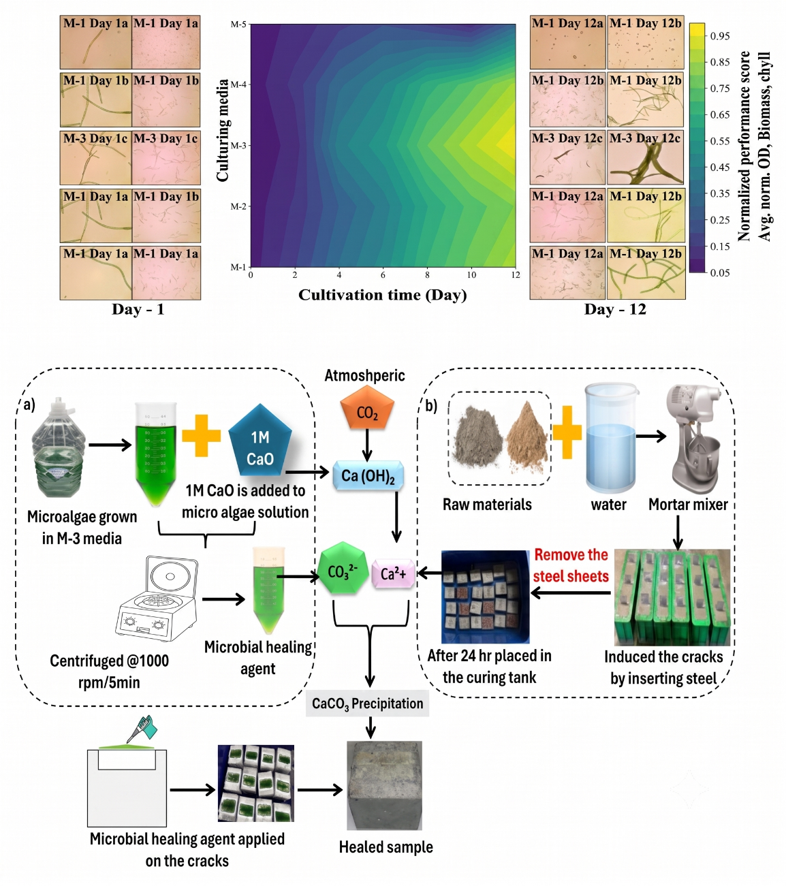
The cultivated microalgae were then applied to repair cracks in cement mortar, which further demonstrates the potential of this nature-inspired technology to create self-healing concrete that can extend the lifespan of infrastructure, reduce maintenance needs, and contribute to more sustainable construction.

Industrial Application

Besides the “healing” properties pioneered by the research team on concrete materials, the benefits of a reduction in cement consumption and carbon emissions were also explored by partially replacing cement with processed microalgae biomass. This green technology further supports the principles of circular economy as it limits waste and harnesses the regenerative ability of natural resources, ultimately providing solutions to improved durability and environmental preservation in the field of construction materials engineering.
This dynamic unification of biotechnology and civil engineering ultimately drives environmentally-informed decisions in the development of durable and sustainable infrastructure.
Researcher featured:

Professor Ir. Dr. Ubagaram Johnson Alengaram
Department of Civil Engineering
Faculty of Engineering
Universiti Malaya
For inquiries, please contact:
Email: johnson@um.edu.my
Contact: +603-7967 7632
Publons Profile: https://publons.com/researcher/1674032/u-johnson-alengaram/
Authors:

Mr. Yandrapati Pierce
Pierce is a PhD candidate in the Department of Civil Engineering, Faculty of Engineering, Universiti Malaya. His research focuses on microalgae-assisted biomineralization for the self-healing of concrete cracks, integrating biotechnology and civil engineering to develop sustainable construction materials.

Ms Eng Pink Huey – Student Writer
Pink Huey is currently a final-year medical student at the Universiti Malaya. Outside clinical wards, her enthusiasm for writing and classical music drives her appreciation for the harmonious union of art and life. For a tinge of adrenaline, she enjoys hiking and chasing sunsets!
Copyedit:
Siti Farhana Bajunid Shakeeb Arsalaan Bajunid, Assistant Registrar, UM


Comments