


Threads of Memory: Unraveling the Sacred Art and Preservation of the Iban Pua Sungkit


Textiles are often seen as beautiful objects, yet in many indigenous societies they are much more than decorative fabrics. Among the Iban people of Sarawak, Malaysia, Pua Sungkit represents a rich tradition of artistic expression, cultural identity, spiritual belief, and intergenerational knowledge.
Handwoven using highly skilled techniques that have been passed down through generations, Pua Sungkit stands as an important example of intangible cultural heritage that continues to connect contemporary Iban communities with their ancestors.
The Roots of Pua Sungkit
Pua Sungkit is a ceremonial textile traditionally produced by Iban women in Sarawak. The term pua refers to a woven cloth, while sungkit refers to a supplementary-weft weaving technique that creates raised decorative motifs on the fabric. Historically, these textiles were used during important rituals, ceremonies, and social occasions and were regarded as valuable cultural objects within Iban society.
Pua Sungkit shares many cultural and ceremonial functions with the more well-known Pua Kumbu but is distinguished by its intricate supplementary-weft decoration, elaborate geometric motifs and vibrancy. Historically, textile mastery was highly respected within longhouse communities, and skilled weavers enjoyed elevated social status because their work reflected not only technical ability but also cultural knowledge and spiritual understanding.
Tracing Pua Sungkit to its Roots
There are two (2) places that still actively weave Pua Sungkit that Dr Gregory visited, namely: Rumah Panjang Puso, Kerangan Mong, Batang Ai, Lubok Antu and Rumah Ngindang, Rantau Kemayau Manis, Ulu Engkari. Even between both places, there were some comparisons drawn. Although the repertoire of 13 main motifs are repurposed, Rumah Panjang Puso is more contemporary in its weaving approach. Men are welcome to weave, and currently there exists 3 generations of weavers, all with the same mindset of passing down the knowledge to the next generation.
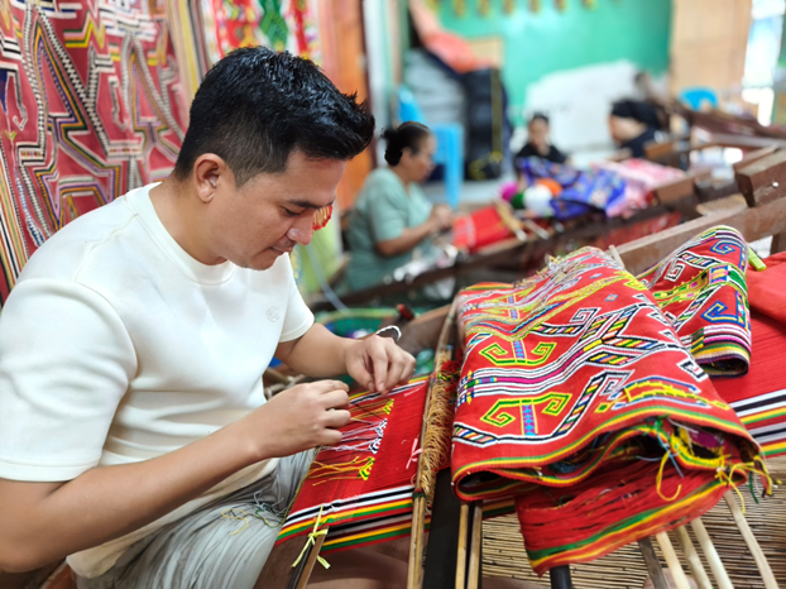
In Rumah Ngindang on the other hand, things are more conservative. Located in the far interior of Sarawak, the community still practices the traditional religion and follows the old rules of only female members of the community weaving Pua Sungkit, that too more often in solitude as they still practice traditional rituals before and during the weaving process. Here, the motifs are no mere symbols, but carry a lot of power spiritually, hence the question of what motif is to be weaved or when it would be completed is rather taboo.
Beyond Just Weaving
Traditional Iban weaving has long been intertwined with spiritual practices and cultural taboos. Weaving was not viewed merely as a craft but as an activity connected to the unseen world and ancestral knowledge. Many experienced weavers believed that designs could be inspired by dreams, visions, or inherited knowledge from earlier generations.
Certain motifs and textiles were historically associated with rituals and ceremonial events. Weavers were expected to observe specific customs and taboos during the production process, particularly when creating textiles intended for ritual use. These practices reinforced the sacred nature of weaving and emphasized the responsibility of the weaver as a custodian of cultural knowledge.
Challenges in Preserving Heritage
Despite its immense cultural value, Pua Sungkit faces significant challenges. Because the wrapping technique is so time-intensive and technically demanding, fewer young weavers learn the skill today. Many antique sungkit pieces have either aged, been sold off to private collectors, or been stored away in museums where their living context is separated from community life.

Preserving Pua Sungkit requires looking at it not just as a physical museum artifact, but as intangible cultural heritage, a living knowledge system that includes oral history, ritual belief, and hands-on craftsmanship
Helping Hands to Preserve Intangible Heritage
Like many forms of Indigenous cultural heritage, Pua Sungkit faces challenges from urbanization, economic pressures, and changing lifestyles. Fewer young people are learning traditional weaving, creating concern over the continuity of specialised knowledge.
To address these challenges, preservation initiatives have focused on:
Documenting weaving techniques and patterns.
Recording oral histories and traditional knowledge.
Conducting community workshops and training programmes.
Supporting local weavers through exhibitions and cultural tourism.
Promoting recognition of weaving as an important form of intangible cultural heritage.
Museums, universities, and cultural organizations have increasingly collaborated with Indigenous communities to ensure that preservation efforts remain community-centred and respectful of local knowledge systems.
Research in Action: Dr Gregory’s Work
One of the leading researchers working on the preservation of Iban cultural heritage is Dr. Gregory Anak Kiyai @ Keai from the Faculty of Creative Arts, Universiti Malaya. Growing up in an Iban longhouse in Sarawak, Dr. Gregory developed a strong commitment to safeguarding Indigenous knowledge and cultural traditions that are increasingly vulnerable to cultural change and globalization.

Having grown up in a traditional Iban longhouse (Rumah Bujang at Rantau Kiran in Limbang, Sarawak), Dr. Kiyai brings an emic (insider) ethnographic perspective to research on indigenous material culture. His work bridges academic institutional preservation and longhouse community engagement. His work with local weavers demonstrates that safeguarding intangible cultural heritage is not simply about preserving the past. It is about empowering communities to carry their traditions, stories, and identities into the future.
Keeping the Threads Alive
Pua Sungkit is far more than a textile. It is an expression of Iban identity, creativity, spirituality, and collective memory. Through its intricate weaving techniques, symbolic motifs, and ceremonial functions, it preserves knowledge that has been handed down for generations. Yet the continuity of this tradition depends on active efforts to document, teach, and celebrate it.
SDGs Addressed
 | Through the emergence of male weavers in a traditionally female craft. |
 | Through ensuring traditional weavers are able to get work opportunities and fair pay through crafts produced. |
 | Through ensuring small enterprises / communities are able to compete on the same ground as commercial entities in producing heritage crafts. |
Researcher Featured

Dr Gregory anak Kiyai @ Keai
Dean’s Office,
Faculty of Creative Arts
Universiti Malaya
Area of Expertise: Material Culture & Arts History > Indigenous Arts and Culture > Art Management
Get to know the researcher:
A trained historian, focusing on materials and museums, Dr Gregory hold Pua weaving close to his heart as his late mother and maternal grandmother, were both weavers originating from Ulu Layar, Saribas, Sarawak. He is of the opinion that museums play a role in allowing us to decolonise the narrative on our communities through learning about our past from our own lenses. He has been featured in media discussing UM’s research into intangible heritage pieces, including that of Pua Sungkit.
For further inquiries, please contact:
Email: gregory.kiyai@um.edu.my
Tel: +60379673288
ORCID ID: https://orcid.org/0000-0002-3714-1347
Web of Science (WoS): https://www.webofscience.com/wos/author/record/KMY-4077-2024
Google Scholar: https://scholar.google.com/citations?user=gregory@kiyai@keai
Author:

Jaiyogesh Ramesh Patel
Research Outreach & Visibility Centre (OVIS), JPP, UM
Copy-editor:
Siti Farhana Bajunid Shakeeb Arsalaan Bajunid
Research Outreach & Visibility Centre (OVIS), JPP, UM


Comments