


The Triumph of Fundamentals in Chemistry

Researcher: Associate Professor Dr. Hairul Anuar Bin Tajuddin
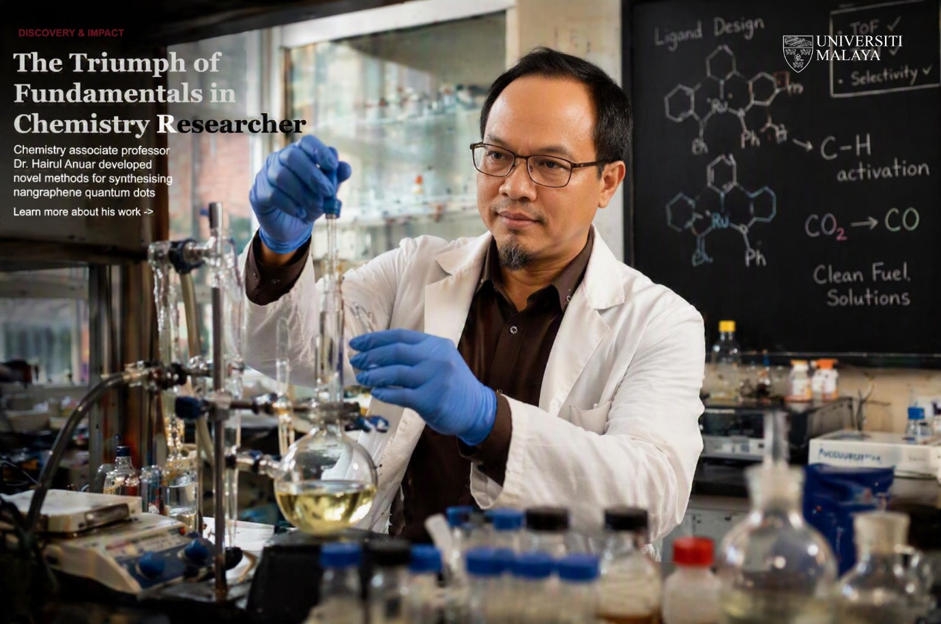
The “Lewis Structure”, “Van-der-Waals forces”, and the “Hammett Equation” were some of the many terminologies within the vast field of chemistry. They may seem and sound daunting to students of the Science stream or alien to the audience of non-science backgrounds; Yet, in a short interview with Assoc. Prof. Dr. Hairul Anuar Tajuddin, it became clear that these seemingly complex ideas are rooted in fundamental principles that underpin the entire field.
“Allah did not create anything in vain.”
Resonating with his motto above, Dr Hairul emphasised that true understanding – regardless of discipline – begins with mastering the basics. In chemistry, both macroscopic and microscopic research efforts build upon these foundations, acting as quiet, often overlooked contributors that drive the field forward.
Introducing Associate Professor Dr Hairul Anuar bin Tajuddin, an academic and researcher at the Department of Chemistry, Faculty of Science, University of Malaya. His academic journey reflects a strong foundation in physical and materials chemistry, having obtained his Doctor of Philosophy in Physical Organic Chemistry from the University of Sheffield, United Kingdom. His scholastic endeavour led to his obtaining a Master of Science in Colloid Chemistry and a Bachelor of Science with Education from the University of Malaya. This combination of training in chemistry and education has shaped his ability to bridge fundamental science and practical application, as well as teaching.
Academic Career

Dr. Hairul’s career has been marked by key transitions that define his research identity. Early in his academic path, his work focused on understanding molecular structure, reaction mechanisms, and physicochemical properties. Over time, this evolved into a strong interest in functional materials and nanostructures, particularly carbon-based nanomaterials, which contributed to material design with real-world technological applications. His fields of expertise include nanographene carbon dots, graphene quantum dots, as well as luminescent materials and nanomanufacturing. Dr Hairul’s fascination with these materials stems from their unique optical, electronic, and chemical properties, coupled with their potential for scalable, low-cost, and environmentally friendly production. Motivated by the global demand for sustainably advanced materials, Dr Hairul and his team pursued further research into the engineering of elementary carbon-based systems into high-value functional nanomaterials. His work is driven by the belief that fundamental chemistry can play a transformative role in addressing challenges in sensing, imaging, electronics, and energy-related technologies.
Scholastic Contributions
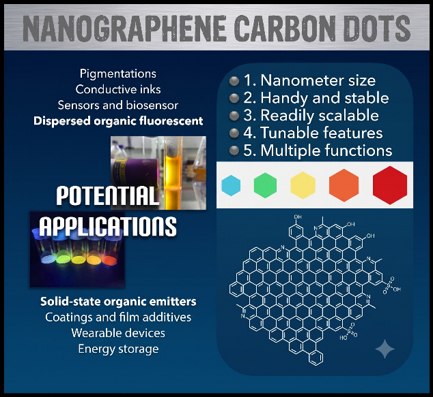
Among his most notable contributions is the development of novel methods for synthesising nanographene quantum dots, including approaches that improve a material’s durability and stability on a nanoscale. These innovations have significantly advanced the understanding of structure-property relationships in carbon nanomaterials and opened new avenues for their commercial use.
However, Dr. Hairul’s research journey has not been without challenges. Issues such as achieving consistent material quality, commercial scale-up synthesis, and the translation of laboratory discoveries into industrial-ready processes have required persistent experimentation and interdisciplinary collaboration.
Industrial Collaborations
Beyond academia, Dr. Hairul engaged in collaborations with industry partners and technology transfer initiatives. His research projects advocate for the development of commercially viable carbon-based nanomaterials that are sustainable, cost-effective, and adaptable for industrial applications. Collaborations typically involve joint research and development, intellectual property generation, and pathways towards commercialisation.
Looking ahead, Dr. Hairul envisions stronger industrial collaborations and broader public engagement to accelerate the adoption of carbon-based nanomaterials in real-world settings. His work has the potential to inform technology development strategies and innovation policies, particularly in areas related to advanced materials, sustainable manufacturing, and high-value chemical products. By aligning fundamental research with national and industrial priorities, he aims to contribute meaningfully to Malaysia’s science and technology ecosystems.
The Future Ahead
Dr. Hairul’s future projects continue to build on his core expertise in nanographene and carbon quantum materials. He believes these initiatives are important as they seek to push the boundaries of functional carbon materials towards greater efficiency, sustainability, and commercial readiness. He remains open to collaboration and strategic visibility, particularly with industry partners, research institutions, and policy-makers interested in advanced materials, green technology, and innovation-driven growth.
Ultimately, through his work, Dr. Hairul exemplifies how deep scientific inquiry, when combined with long-term vision and collaboration, can transform fundamental chemistry into impactful technological solutions!
Researcher Featured:
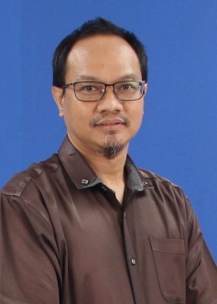
Associate Professor Dr Hairul Anuar Bin Tajuddin
Department of Chemistry
Faculty of Science, Universiti Malaya
Area of Expertise:
Chemistry > Physical Organic Chemistry > Material Synthesis
For inquiries, please contact:
T: +60379674053
Researcher ID: B-8570-2010
Scopus ID: 24767916000
Author:

Ms Eng Pink Huey
Pink Huey is currently a final-year medical student at the Universiti Malaya. Outside clinical wards, her enthusiasm for writing and classical music drives her appreciation for the harmonious union of art and life. For a tinge of adrenaline, she enjoys hiking and chasing sunsets!
Copyedit:
Siti Farhana Bajunid Shakeeb Arsalaan Bajunid, Assistant Registrar, UM


Comments